Why the future of data looks a lot like the past of newspapers
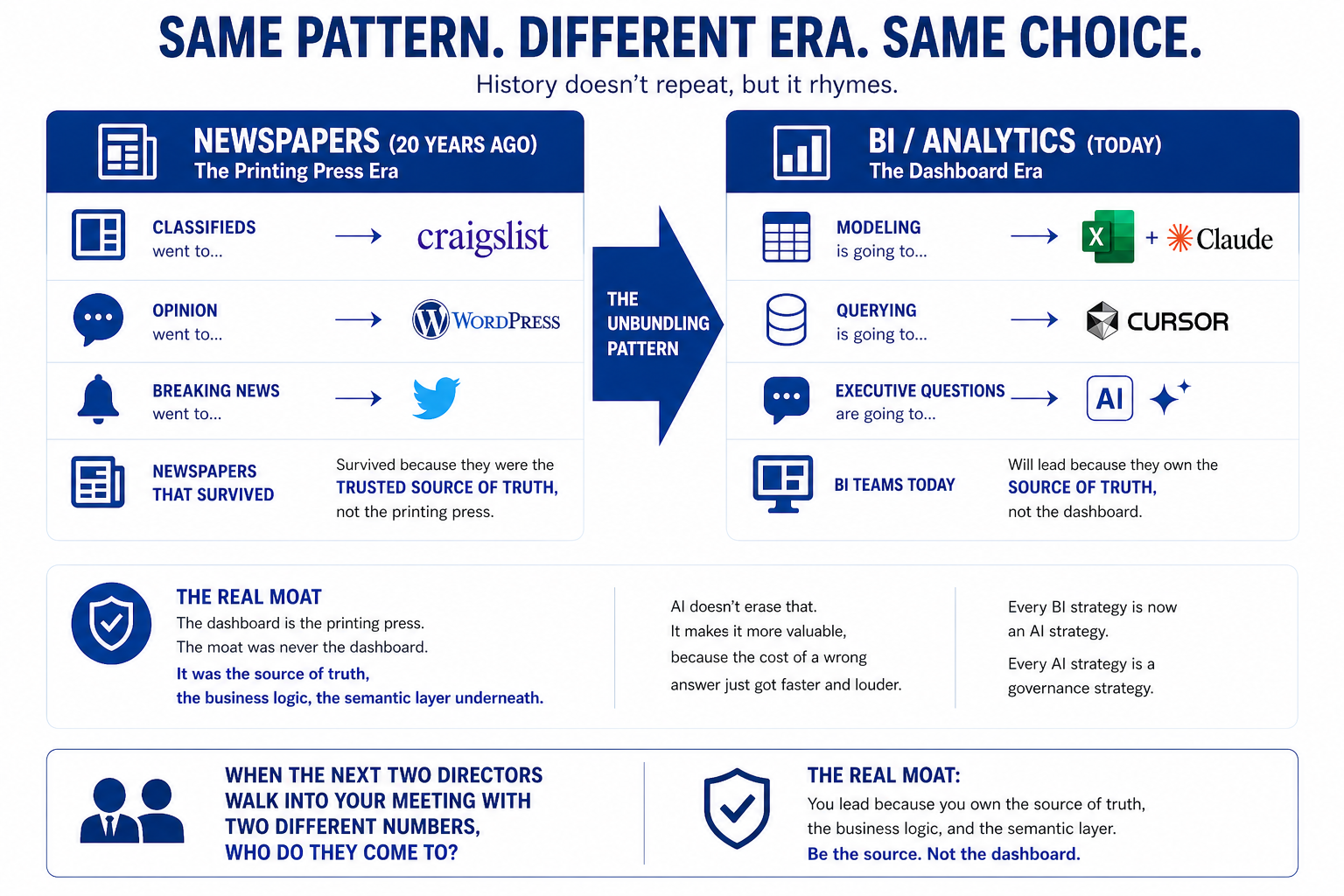
Twenty years ago, newspapers were not killed by a lack of demand for news. The audience never went away. What went away was the bundle. Classifieds went to Craigslist. Opinion went to blogs. Breaking news went to Twitter. Investigative reporting went to substacks and podcasts. Every piece of what a newspaper used to deliver got pulled out and delivered better, faster, or cheaper somewhere else. The newsrooms that survived were the ones that figured out their value was never the printed paper. It was the editorial judgment, the trust, the source verification. Everything else was delivery format.
Business intelligence is going through the same unbundling right now, and most data leaders are defending the wrong asset.
The Dashboard Is the Printing Press
For two decades, BI teams built their identity around the dashboard. We hired for it, organized around it, measured ourselves on how many we shipped. It was the artifact that proved the team existed.
Look at where the work is actually moving. Finance teams build models in Excel paired with Cowork. Product managers query warehouses through Cursor. Executives ask Claude what they used to ticket to analytics. The interface is fragmenting across AI chats, IDEs, MCP servers, and tools we have not seen yet.
The dashboard is not dying because nobody wants data. It is dying because the delivery format is being routed around.
The Joke That Tells You Where the Moat Actually Is
Every BI team has the same running joke. Marketing always says they just need directional data. Then two directors walk into the same meeting with two different numbers, and suddenly the request comes back: who owns the source of truth on this?
That moment is the entire reason BI teams exist. It is also the moment most data leaders mistake for job security, when in fact it is the clue to where the work is moving.
The directors-with-different-numbers moment is not going away in an AI world. It is getting worse, because now everyone has a tool that will confidently produce a third number, in plain English, in seconds. The team that owns the answer to "which number is right" becomes more central, not less. The team that owns the dashboards those numbers came from becomes less central, not more.
The value of BI was never the chart. It was the source of truth and the business logic that made one number mean the same thing in finance, in operations, and in the boardroom. The trust that when someone asked "what was revenue by region last quarter," the answer was the answer.
That moat does not disappear in an AI world. It becomes more important, because the cost of a wrong answer just got faster and louder. A confident hallucination delivered in plain English at the speed of conversation is more dangerous than a wrong number on a dashboard nobody opens.
Semantic layer, data contracts, governance, lineage, documentation. This is the editorial judgment of the data world. It is what stands between AI and a company-wide game of telephone. Companies that invest in it now are building the trust layer for every AI tool they will adopt over the next decade.
The Productivity Shift
The work that used to take a BI analyst a week, gathering requirements, building the dashboard, iterating on visuals, getting it deployed, can now be produced by a business user in minutes through AI. That is not a threat to productivity. It is a redefinition of where productivity comes from.
The leverage is no longer in building artifacts. The leverage is in governing the data those artifacts are built from. A well-defined semantic layer turns every AI tool in the company into a force multiplier. Without one, every AI tool produces fast, confident, wrong answers. The 10x gains people talk about with AI in the enterprise are not coming from individual productivity tools. They are coming from letting AI safely operate against trusted, contracted data at scale.
This is also why automation costs drop. When AI can reliably answer routine questions against a governed semantic layer, the queue of repetitive analytics requests collapses. The team is not displaced. The team is freed to do work that requires judgment, context, and modeling that AI cannot do alone.
The Upskilling Truth
The skill stack reordered. The analyst whose career was built on dashboard craft is in the same position as the print-only journalist twenty years ago. Still useful, no longer central.
The new profile blends semantic modeling, data contract design, AI fluency, and product ownership. The analyst who can build a dashboard, write a semantic layer, design an MCP tool, and prompt an LLM to surface the right answer becomes more valuable. The analyst who can only do one of those things is in trouble.
Data science still happens. Analytics engineering still happens. They get compounded by AI agents working against governed data, which drives automation costs down while expanding what a small, well-skilled team can deliver. Some roles will sunset. Some new roles will get created. The teams that name this clearly to themselves and to their people will move faster than the teams that pretend nothing is changing.
Upskilling is real and necessary. It is also not a way to avoid the harder conversation about who does what.
The Unsexy Work Just Became the Unlock
Semantic layer. Data governance. Data contracts. Documentation. Lineage. These were the words every analyst dreaded hearing in a planning meeting. Nobody wanted to own them. Nobody got promoted for them. They were the chores you did between the fun work, the things you put on the roadmap and quietly slipped to next quarter.
For twenty years, we treated this work like flossing. Necessary, virtuous, and almost universally avoided.
Then AI showed up and changed the math.
The boring work is the only thing that makes AI safe to point at company data. A clean semantic layer is the difference between an AI that produces real answers and one that confidently makes them up. Data contracts are what stop a marketing team from getting a third version of revenue from a chatbot. Governance is what makes the security team say yes instead of no.
Agent-ready data is the actual moat, and it is built out of all the chores nobody wanted to do.
The fear of exposing company data to AI, which is the real reason most enterprise AI pilots stall, gets solved by the same work. You do not keep AI away from the data. You control exactly what it sees, through what interface, with what permissions, and with what audit trail. The governance work is the productivity work. We just used to be allowed to ignore it.
Every BI strategy is now an AI strategy. Every AI strategy is a data strategy. The leaders pulling ahead are the ones who finally got excited about the boring stuff.
What This Means for Leaders
Fund the moat, not the output. The semantic layer, data contracts, and AI-ready infrastructure are core product, not side projects. They are what every other AI investment in the company depends on.
Make BI strategy and AI strategy the same conversation. The teams that separate them end up with either ungoverned AI that creates risk, or governed data no AI tool can reach. Neither unlocks anything.
Reshape the team with intent. Redeploy capacity toward semantic modeling, AI tooling, and data product ownership. Hire for the new profile. Be honest with the team about what is changing and when.
Position the data team as the trust layer for enterprise AI. Every AI tool the company adopts is only as good as the data it touches. That makes the data team the critical path for AI rollout, not a reporting function downstream of it.
The Risk of Not Acting
The business will use AI with or without the data team. They are already doing it. If the data team is not the trusted layer underneath every AI interaction, two things happen. The moat gets rebuilt by someone else, probably outside the team. And the first major data exposure or accuracy incident gets written about somewhere else, with the company's name in the headline.
The newspapers that survived did not survive because they printed prettier papers. They survived because they were the trusted source for millions of people. Everything else was delivery format.
The BI teams that survive will not be the ones that ship prettier dashboards. They will be the ones that became the trusted source for everyone else who is now building with AI.
When the next two directors walk into a meeting with two different numbers, the team they come to is the team that wins the next decade.
Justin Grosz writes about enterprise AI, data strategy, and the operating models that make them work. Follow JAKT.AI for more on building AI-native data organizations.