Motorsport has a dirty secret that nobody wants to talk about: the best drivers don't always win. The richest ones do.
And if you're running a team in corporate America, you might have the exact same problem.
The Racing Version of This Problem
I grew up around motorsports, and two things have always frustrated me about the sport.
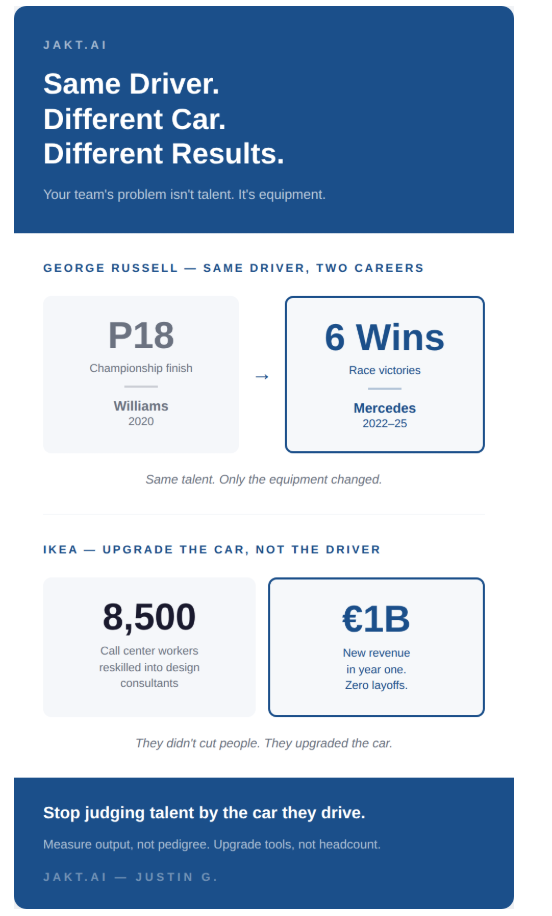
You can't tell who's actually good. George Russell spent three years at Williams, finishing as low as P18 in the championship. Then he moved to Mercedes and racked up six wins. In 2020, when he subbed in for Lewis Hamilton at Sakhir, he nearly won the race on his first weekend in the car, missing pole by 0.026 seconds. Same driver. The only thing that changed was the equipment.
Money wins. Before F1's budget cap, top teams spent over $400 million a year while smaller outfits operated on a fraction. Even today, teams find creative ways around the cap. The playing field is flatter, but far from level.
Billy Beane faced the same problem in baseball. The Oakland A's in 2002 had a $44 million payroll competing against the Yankees' $125 million. His solution: stop scouting on who "looks the part" and start measuring actual output. On-base percentage over batting average. Walks over stolen bases. The entire industry was pricing talent on aesthetics. Beane priced it on performance.
Motorsport needs the same revolution. But more importantly, so does your company.
Now Apply This to Your Company
These aren't just racing problems. They're organizational problems. And if you're a leader, you're probably dealing with both of them right now.
Your "George Russell" Problem: Finding Hidden Talent
Most hiring processes are the equivalent of judging a driver by their car. We look at the brand name on the resume, the school, the previous employer. We're scouting on aesthetics, who "looks the part," rather than who actually performs.
Worse, most companies hire from the same talent pool as their competitors. They're all fighting over the same "Mercedes drivers," the candidates with the big-name experience and the polished LinkedIn profiles. That's expensive, and it doesn't get you innovation. It gets you more of what everyone else already has.
The real Moneyball move is hiring for curiosity, drive, and the ability to build. Before we even have a real conversation with a candidate, we ask them to complete a case study or show us their GitHub. Show me what you've built. Show me that you're hungry enough to create things on your own time. I'm almost 34, and I'm shipping projects to GitHub nearly every week. If someone half my age who wants to work in data science or AI engineering can't demonstrate that same drive, that tells me everything I need to know. Not about their skills today, but about their trajectory.
Stop competing for the same talent your competitors want. Start finding people with the skills you actually need, people who are building, experimenting, and solving problems nobody asked them to solve. The best talent might be sitting in a "Williams" right now: an under-resourced team, a no-name company, a non-traditional background, producing quietly brilliant work that nobody's paying attention to.
Your "Budget Cap" Problem: Are You Giving Your Team the Right Tools?
The second racing problem, money concentration creating uncompetitive fields, has a direct corporate analog. But it's not always about spending more. Sometimes it's about spending on the wrong things. Or worse, taking away the things that were working.
IKEA's story is the gold standard here. When they deployed their AI chatbot "Billie," it handled about 47% of routine customer inquiries without human intervention. Most companies would have celebrated the cost savings and started cutting headcount. IKEA did the opposite. They analyzed the remaining queries that the bot couldn't handle and discovered customers were asking for interior design advice, a high-value service that required human judgment. So instead of laying people off, IKEA reskilled 8,500 call center workers into interior design consultants. The result? Nearly €1 billion in new revenue in the first year, and not a single layoff.
The lesson isn't "deploy AI." The lesson is: are you giving your people the right tools to succeed, and then getting out of their way?
Ramp just showed what this looks like at scale. They hit 99% adoption of AI tools across the company and then realized most employees were stuck. The models were good enough. The problem was that terminal windows, npm installs, and MCP configurations were too much for most people. So they built Glass, an internal AI productivity suite that auto-configures on login and connects to every company tool. They also created "Dojo," a marketplace where one person's breakthrough workflow becomes a reusable skill for the entire organization. One employee figures out how to analyze Gong calls and draft battlecards? That becomes a skill every rep on the team can use instantly.
I've watched organizations do the opposite: strip away tools that teams relied on. Analytics platforms, development environments, collaboration software. All in the name of cost savings. They don't replace them with anything better. Then they wonder why productivity drops and talent leaves. You didn't have an ideas problem or a talent problem. You had a tools problem. Your people were driving a Williams when they needed a Mercedes.
The Bottom Line
Whether you're running a racing team or a business unit, the playbook is the same:
Stop evaluating talent by the car they're driving. Build systems that measure actual performance, adjusted for context. Look for hunger, curiosity, and output, not pedigree.
And stop assuming your best teams are your best-funded teams. Sometimes the most transformative thing you can do is give your scrappiest people disproportionate access to the right tools and let them innovate their way to results.
Billy Beane proved it in baseball with a $44 million payroll. IKEA proved it by turning customer service reps into design consultants. Ramp proved it by building every employee their own AI coworker. George Russell proved it every time he dragged a Williams into positions it had no business being in.
The question is: are you willing to look past the car and bet on the driver?
Justin G. | JAKT.AI | Exploring how AI reshapes strategy, talent, and competitive advantage.