Everyone is using AI now. That part is settled. The question nobody is asking is whether anyone is checking the work.
I don't mean running a spell check or skimming for obvious errors. I mean actually validating whether the output is right. Whether the number makes sense. Whether the query pulled from the right table. Whether the recommendation accounts for the thing that changed last quarter that only three people in the company know about.
Most people can't do that. Not because they're careless, but because they don't know enough about the business or the systems to know what wrong looks like. They auto-accept. They paste the output, send the email, ship the dashboard. And nobody catches it until a VP asks why the number doesn't match what she saw last month.
The most valuable AI skill right now isn't prompting. It's knowing your domain well enough to validate what AI gives you.
The Mess Nobody Mapped
Here's the thing about domain knowledge that makes it so hard to replace: most of it was never written down.
A YC-backed company called Foaster just built an entire business around this problem. Their system interviews employees across an organization, from frontline to leadership, and maps how work actually gets done. Not how the org chart says it works. Not how the process doc from 2019 describes it. How it actually runs today, with all the workarounds, handoffs, and undocumented dependencies that keep things moving.
In one engagement, they documented over 1,200 processes across a 350-person company. Think about that. Twelve hundred processes that existed in people's heads, in tribal knowledge, in the way someone learned to do something five years ago and never told anyone else.
If the people inside a company can't articulate how it works, how would an AI get it right? And if AI gets it wrong, who catches it?
Domain Knowledge Has Two Sides
When people hear "domain knowledge," they think industry expertise. Healthcare regulations. Financial reporting standards. Supply chain logistics. That's one half.
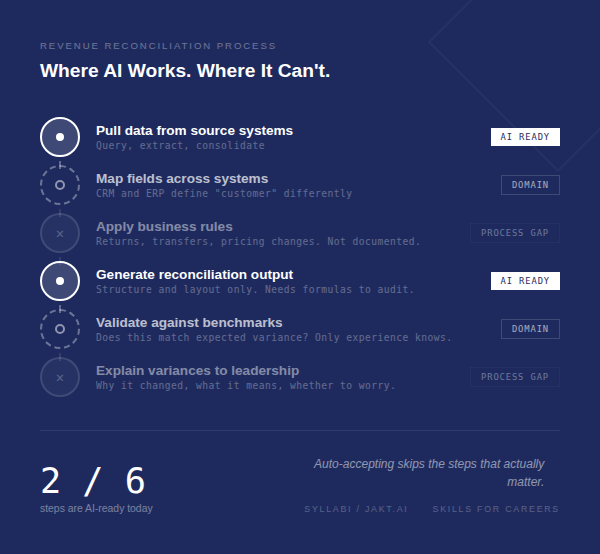
The other half is technical. It's knowing your data model, your tech stack, how your systems connect, where the legacy quirks live. It's knowing that the CRM and the ERP don't agree on how they define a customer. It's knowing the API returns timestamps in UTC but the dashboard assumes Eastern. It's knowing that report breaks every quarter-end because someone manually updates a config file and occasionally forgets.
Last week I asked Claude to build a reconciliation worksheet. It came back clean. Labeled columns, organized rows, numbers that looked reasonable. But there were no formulas. Every cell was a hardcoded value. It looked like a reconciliation but it couldn't actually reconcile anything. You couldn't trace a number back to its source, update an input, or audit the logic. If I had auto-accepted it and sent it to my team, nobody would have caught it until someone tried to use it. I caught it in ten seconds because I've built reconciliations before. That's not an AI skill. That's domain knowledge.
AI doesn't have either kind of domain knowledge. It has general knowledge. It can write a query that's syntactically perfect and logically wrong because it doesn't know YOUR business and it doesn't know YOUR systems. The person who holds both is the one who validates. And that person is becoming the most important one on the team.
How You Get It (And Why AI Is Making It Harder)
Domain knowledge isn't something you learn from a course or a certification. It accumulates. You pick it up from the person two desks over who has been running that process for six years and knows every edge case. You learn it in the conversation after the meeting where someone says "yeah, that report is technically right but nobody uses that number." You absorb it at lunch, on the Slack thread that goes sideways, in the onboarding session where someone walks you through the real workflow instead of the documented one.
AI is quietly cutting off that pipeline. People are heads-down prompting instead of asking the colleague next to them. They're generating answers instead of having conversations. And every interaction they skip is domain knowledge they never acquire.
This is the part that worries me more than job displacement. Remote work reduced the surface area for knowledge transfer. AI is reducing it further. People are more isolated from each other than they have ever been, and the cost isn't just loneliness. It's competence. You can't validate what you never learned. And you can't learn what nobody shared with you.
The Playbook
If you want to be the person who validates, start with the work nobody assigns you. Map a process. Not the clean version from the wiki. The real one. Talk to the person who actually does it and write down what they tell you. You will be stunned by how different it is from what leadership thinks is happening.
Learn your data. Not the dashboard. The tables underneath it. Know where the numbers come from, what gets excluded, and which filters change the story. When AI gives you an answer, you'll know whether to trust it.
And invest in your team. Not as a management platitude. As a knowledge strategy. The person who knows the workaround, the edge case, the thing that broke last time and how they fixed it, that person is your validation layer. If you don't know what they know, you're flying blind with a copilot that can't see the terrain either.
In a world where everyone has access to the same AI, the differentiator isn't who can generate the fastest. It's who can tell you whether the output is actually right.