In the Spirit of Half-Baked Ideas
Bill Simmons has run a segment for years called half-baked ideas: take a premise that has no business working, treat it with total seriousness, and see what falls out. This is one of those. And like all good half-baked ideas, it starts with Kyle Korver and a copy machine.
In 2003, the New Jersey Nets drafted Korver with the 51st pick, decided they had no roster spot for him, and sold his rights to Philadelphia for $125,000. With some of the leftover money, they bought a copy machine for the front office. Korver played 17 seasons, made an All-Star team, and retired as one of the greatest shooters in NBA history. The copy machine broke in 2017. Korver tells the story himself: "What's your trade value? Mine was a copy machine. And I'm still playing."
That is why Korver matters here. Sports prices every single person in the league, ruthlessly and in public, and the league survives it. So do the players. Corporate America has decided the question is unaskable.
The Meeting You Have Sat In
The work has changed shape and the team has not. You have two data engineers maintaining pipelines that mostly maintain themselves now, and the thing actually blocking you is one backend engineer you do not have. Headcount is frozen. Your options are a req that takes two quarters to fill, or quietly stretching the people you have across work they were never hired to do. The labor market offers exactly one mechanism for fixing a mismatched roster: someone quits, and everyone starts over.
The Trades Already Started. They Just Have Lawyers.
Last July, Google did not acquire Windsurf. It paid roughly $2.4 billion in licensing fees and compensation, took a nonexclusive license to the technology, and hired CEO Varun Mohan, his co-founder, and a handful of senior researchers into DeepMind. No acquisition. No merger review. No roster. Strip the legal language and it is a transfer fee: the acquiring club paid the losing club for its franchise player. Days later, Cognition acquired what remained, the product, the IP, the rest of the team, and accelerated everyone's vesting on arrival. A rescue trade, with the new club honoring the old contracts.
Compare that to the year before, when Brian Niccol left Chipotle for Starbucks and close to $30 billion in market value moved in a single afternoon. Chipotle's compensation was a press release. Business has always done transfers. It just skips the fee.
We're a Team, Not a Family. Prove It.
Tech leadership loves the Netflix line: we are a team, not a family. It shows up in every reorg memo, usually one paragraph before the part where people lose their jobs. Fine. But teams trade. Teams pay transfer fees. Teams honor the contracts of players who get moved, and the league re-grades the deal a year later to see who actually won. If you only reach for the sports metaphor when it is time to cut someone, you do not believe in the metaphor. You believe in the cut.
Because run the counterfactual. A layoff is what a missing market looks like. The company pays severance to make talent leave, hands its competitors free agents at zero cost, and torches years of context on the way out the door. Six months later, someone in the same building pays a recruiter to find those exact skills again. In sports terms, a layoff is waiving half your roster for nothing. Even the worst GM in the league gets a draft pick back for a salary dump.
And here is the tell that most layoffs are not really about headcount: companies cut thousands in one org chart while opening reqs in another, the same quarter, sometimes the same week. That is not a too-many-people problem. That is a wrong-shaped-roster problem wearing a too-many-people costume. A trade market would split those apart. True contraction, when the whole business shrinks, might still mean cuts. But the wrong-shape problem, which is most of them, becomes a trade: the sending org gets value back instead of a severance bill, the receiving org gets vetted talent with context still warm, and the person moves with a contract honored instead of a COBRA packet. Would we still have mass layoffs? Some. Would we have this many? Not a chance.
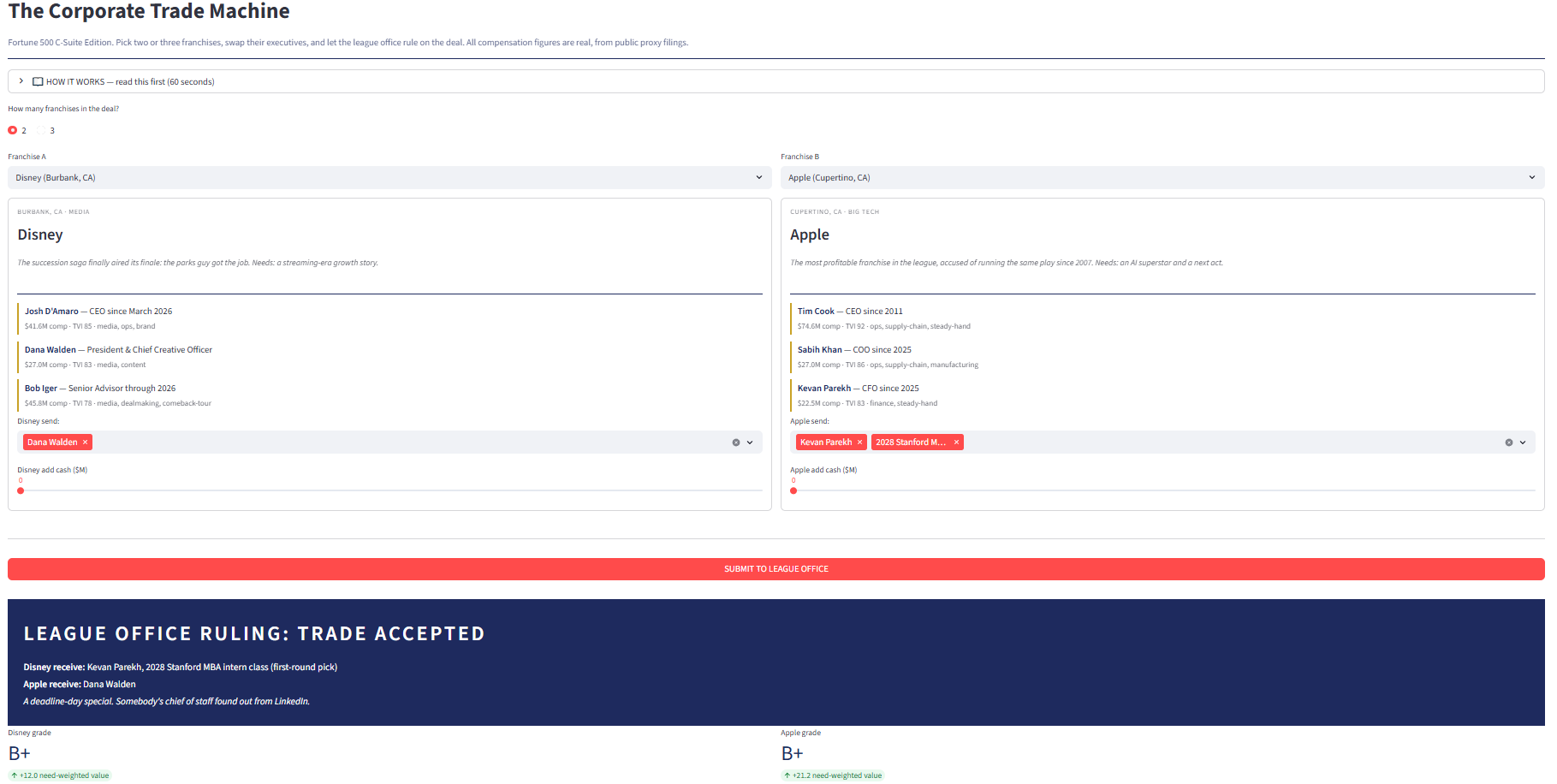
So take the metaphor seriously, half-baked style. Open the Corporate Trade Machine. Your Series B desperately needs a director who has seen scale. The enterprise across town has three of them, two of whom now spend their days doing QA on each other's slide decks. Salaries do not match? The mature org pays down comp for a year, the way NBA teams eat salary to make the math work. Nobody moves without consent; every employee holds a no-trade clause and waives it only for a destination they want. Add cash considerations and a future intern class to balance the deal. The machine blinks green: TRADE ACCEPTED.
My Dad and My Uncle Beat Google to It
The obvious objection is that business has no game film. Leagues can trade because performance is legible: stats, tape, scouts, a public record of what a player is worth. No company can price the marginal value of a data engineer. Most cannot price their own.
Except this market already exists, and has for generations. It just never made it into an office. My dad worked construction. My uncle was a mason. When my dad's jobs went slow, he sent laborers over to my uncle's crew, and when the masonry work stacked up, the favor came back the other way. No platform, no lawyers, no six-month req. It worked because both of them could see exactly what a laborer was worth. The work was legible. Nobody needed a scouting report. The wall was the scouting report.
And note the irony for the team-not-a-family crowd: the most functional talent market I have ever seen was run by an actual family.
So look at where the talent trade actually lives. At the very top, where Google can wire $2.4 billion because Varun Mohan's value is public knowledge. And on the job site, where two crews swap laborers over a phone call because the output is visible to anyone standing nearby. The only people with no market at all are the ones in the middle. Knowledge workers. The work nobody can see.
Game Film for the Rest of Us
That is the gap AI is closing, mostly by accident. The tooling flooding into your workflow is producing the first game film in white-collar history: commits, artifacts, agent logs, the visible shape of how someone actually works. The middle of the curve is becoming legible, whether or not anyone builds a market on top of it.
And maybe nobody has to build it. My dad's version required no startup, just two people who trusted each other and could see the work. The corporate version requires an HR function ambitious enough to do what a foreman does instinctively: know what the roster is worth, know who is underused, and pick up the phone.
Until then, sit with Korver's question, because for the first time in your career there will soon be an actual answer. What is your trade value? His was a copy machine. He outlasted it. Would you?
Sources: CNBC and Reuters (Google-Windsurf deal terms, July 2025); CNBC (Cognition acquisition of Windsurf, July 2025); ClutchPoints and Korver's 2019 Creighton commencement speech (copy machine trade); Investing.com and TipRanks (Niccol announcement-day stock moves, August 2024).