There's a debate consuming tech right now: what happens to entry-level roles in an AI world? Every week there's a new article arguing that AI will eliminate entry-level technical jobs such as data analysts and software engineers. Does that mean companies will stop hiring juniors entirely, or that the career ladder is about to lose its bottom rungs?
I've spent the last decade teaching data and analytics at the graduate level. And from where I sit, the talent pipeline was breaking long before AI entered the conversation. What's interesting is that the very decline happening in academic programs might be what forces the correction everyone is waiting for.
What Broke
Ten years ago, I walked into a classroom at BU to lecture for the first time. I taught a Marketing Analytics course focused on students mastering Excel, SQL, and how to think through a business problem with data. From the start, I've always taught to the workplace, not to theory. Case studies over textbooks. Real datasets over clean ones. The question I ask myself before every class: would this help someone be effective on day one of a job?
That approach worked. My students got hired. Companies recruited from these programs because they trusted that a graduate could step in and contribute.
Things were going relatively well until Covid, which put education into shock and, as we'll get into here, still hasn't recovered. Programs were in a rush to revamp curricula (I even helped rewrite a course) to accommodate the future of learning. But instead of refocusing on the skills students would need to do the day-in and day-out work, they went purely technical. If interviews were going remote, then hiring would lean more on exams and less on personality. The shift led to programs focusing heavily on Python and theory, chasing the "data science" label (remember it was named the sexiest job of the 21st Century so why not optimize on that) and the enrollment it attracted.
Meanwhile, most companies still run on Excel and SQL with sporadic Python (AI is starting to shift that a little). Grad students spend semesters on concepts more relevant at the doctoral level while never learning to frame a business problem or present a finding to a non-technical stakeholder. The Cengage Group's 2025 Graduate Employability Report backs this up: only 30% of graduates found full-time work in their field, 48% reported feeling unprepared to even apply for entry-level positions, and half of educators dedicate 20% or less of their curriculum to workforce skills. The gap between what's taught and what's needed widened, and employers noticed. This is where the trust between academia and corporations began to erode, not AI.
Then there was the financial incentive. These programs were already rising in popularity, and if they could be taught in a more hybrid approach, that made them more profitable. International tuition filled seats and funded departments. Graduate enrollment actually grew 3.6% during the pandemic while undergraduate enrollment dropped, largely because online delivery made scaling easier. The incentive shifted from building strong programs to maximizing enrollment. When the quality of graduates stopped matching what employers were sold on, companies pulled back. Many now require a PhD for data science roles, and entry level analyst positions that used to be the natural landing spot became harder to come by.
So when people ask "will AI eliminate entry-level roles?", my answer is: companies were already distancing themselves from recent grads before AI gave them a convenient reason to formalize it.
And Then AI Sped It Up
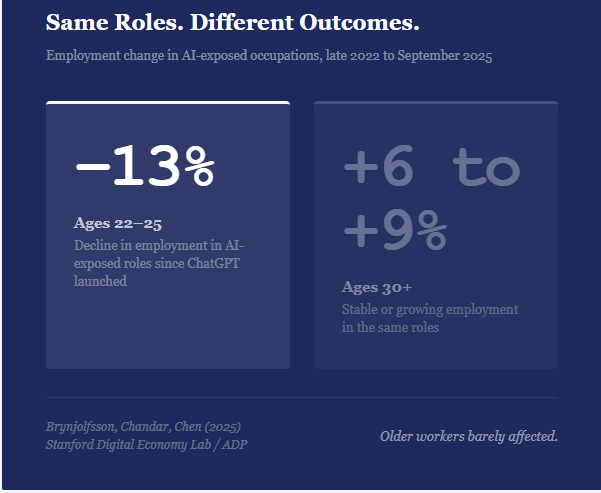
The data is starting to back this up. Derek Thompson has been tracking what he calls the "new grad gap," the difference in unemployment between recent graduates and the overall economy, which just set a modern record. I'd recommend his pieces in his Plain English newsletter and podcast, particularly "The Evidence That AI Is Destroying Jobs For Young People Just Got Stronger." A Stanford study of ADP payroll data found that workers aged 22 to 25 in AI-exposed roles saw a 13% decline in employment since the launch of ChatGPT. Older workers in the same roles were barely affected.
How do we flip this narrative going forward?
Just this past week, Goldman Sachs announced a partnership with Anthropic to deploy AI agents across trade accounting, compliance, and operational finance. Those aren't the analyst roles that analytics graduates typically target, but they signal something important: if AI can automate complex, rule-based review work at a firm like Goldman, the floor for what justifies a junior hire drops across the board. A role that paid $50-60K starts looking more like intern-level compensation. As Erik Brynjolfsson, the Stanford economist behind the Stanford study above, put it: universities haven't updated their curricula to match how people actually work on the job. The salary premium for an analytics master's degree is shrinking, and with it, the economic case for an international student to spend six figures on a US program. Enrollment pipelines that programs built their revenue models around will thin out.
The problems in the classroom and the problems in the job market aren't separate. They feed each other. Curriculum drifts from what industry needs, graduates aren't prepared, employers pull back, salaries compress, enrollment softens, and programs lose the resources to fix the curriculum. It's a cycle. And AI just sped it up.
What Fixes It
The good news is that the same pressures breaking the system are creating the conditions for something better.
Start with the programs themselves. The economics are going to force curriculum reform. Programs that survive will be the ones producing graduates companies actually want to hire. That means less theory, more case studies, more business domain knowledge, more practical readiness. MBA and analytics programs will continue merging, and that's the right move. Analytics graduates lack business context. MBA graduates lack technical fluency. The blend addresses both gaps. I wouldn't be surprised to see MBA programs absorb standalone analytics programs entirely within the decade.
The recruiting process is also ripe for reinvention. Right now it's a black box of keyword-matching algorithms that rewards credentials over capability. Graduates can't show what they can do, and companies can't see past a resume. I've believed for years there is innovation just waiting to happen at the intersection of TikTok, LinkedIn, and GitHub: a platform where candidates demonstrate their work, signal their interest in a company or area, and employers evaluate capability rather than pedigree. The gap between frustrated graduates and hesitant employers is wide enough that this kind of innovation feels inevitable.
What You Can Do Today
You don't have to wait for programs or platforms to catch up. You've probably heard the line: you won't be replaced by AI, but you will be replaced by someone who knows how to use AI better than you. That's not a bumper sticker. It's the new baseline.
Greg Shove and Taylor Malmsheimer wrote a piece this week in their Personal Math newsletter called "How to Make AI Your Coworker in 72 Hours." Their advice is practical: block off a few hours, suspend your skepticism, and give AI your hardest problem, not a softball. They found that most people are stuck in the middle, getting pressure to adopt AI but not doing anything meaningful with it. The fix is spending real time with the tools on real problems.
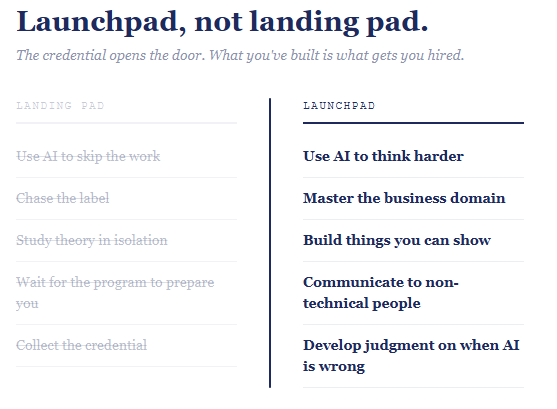
I'd take it a step further. The skills that differentiate you now are the ones AI and most programs both leave open. Understand business domains deeply enough to know which questions to ask, not just how to query the data. Communicate findings to people who don't speak SQL (I would recommend trying this on a friend, not a spouse). Develop judgment about when a model's output is wrong, not just how to run one.
Use your time in a grad program to position for the world of AI
And if you're in a graduate program right now, you have an advantage you might not realize: time. Use it to actually master AI, not just lean on it. Ironically, since AI tools became widely available, I've seen grades decline, not improve. That tells me most students are using AI to avoid the work rather than deepen it. The ones who figure out how to use these tools to think harder, not less, are the ones who will stand out. Treat your program as a launchpad, not a landing pad. The credential opens the door. What you've built and what you can articulate about it is what gets you hired.
The system is correcting. Make sure you're correcting with it.
Thank you for reading. If you like the newsletter feel free to forward along and help drive new eyes to Syllabi!