Everyone wants an AI agent. Most organizations haven't done the prerequisite work to make one useful.
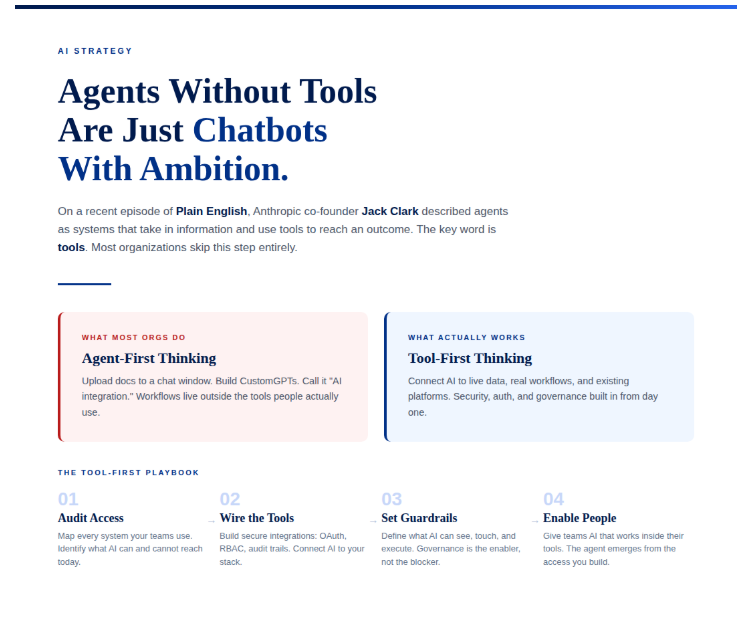
On a recent episode of Plain English, Anthropic co-founder Jack Clark described agents as systems that can take in information and use tools to reach an outcome. The key word in that framing is tools.
An agent without tools is just a chatbot with ambition. And right now, most organizations are pouring energy into the agent conversation while completely ignoring the tool conversation.
The CustomGPT Hangover
In 2025, companies proudly waved their OpenAI trophies. Usage dashboards looked great. Teams built CustomGPTs, uploaded documents, and generated outputs. It felt like progress.
But it created two dangerous habits. First, the belief that dumping files into a chat window and getting a response is "AI integration." Second, the assumption that this was the ceiling, that a standalone chat experience was the end state for enterprise AI.
It wasn't integration. It was isolation. Those workflows lived outside the tools people actually used to do their jobs.
What Tool-First Actually Looks Like
Companies like Ramp have shown what happens when you flip the script. Instead of asking "how do we build an agent," they asked "how do we give AI access to the systems where work already happens?" The result is AI that acts on real data, in real workflows, producing real outcomes.
Claude has leaned into this with MCP and native tool integrations that connect AI directly into enterprise systems. The difference is not subtle. When AI can pull live data from your warehouse, trigger actions in your platforms, and operate within your existing security model, you stop needing to copy-paste context into a chat window. The work happens where the work already lives.
This shift has gotten so powerful that organizations are reconsidering entire product investments. If Claude with a few well-configured tools can replace a custom-built internal agent, the ROI math on building that agent from scratch collapses.
Why Organizations Skip This Step
Because tool access is unsexy and hard. It means having real conversations about security, authentication, and governance. It means deciding which systems AI can touch, what data it can see, and who gets access to what. It means managing OAuth flows, role-based permissions, and audit trails.
None of that makes for a good keynote slide. "We built an agent" sounds better than "we spent three months getting our IAM policies right so AI could safely query our data warehouse." But the second one is what actually unlocks value.
The Monday Morning Question
Before your next conversation about agents, ask your team this: what tools does our AI have access to today? If the answer is "a chat window and some uploaded PDFs," you are not ready for agents. You are ready for a tool integration strategy.
The organizations that will win with AI over the next three to five years are not the ones that shipped an agent first. They are the ones that built the foundation first: secure tool access, governed integrations, and a trust model that lets people connect AI into the way they actually work. That foundation compounds. Every tool you wire in makes the next one easier. Every guardrail you set makes your teams more confident to push further. Every integration you get right makes the agent conversation worth having.
The short-term win is a demo. The long-term gain is an organization where AI is not a side tool but a connected layer across how your teams operate, learn, and deliver. That is not a quarter-long initiative. That is a multi-year advantage that gets harder to replicate the earlier you start.
Stop chasing the agent. Start wiring the tools. The compounding starts now.