Boris Cherny, the head of Claude Code at Anthropic, said something last month that broke the internet: he hasn't written a single line of code by hand since November. 100% AI-generated. 22 pull requests in a day. And Anthropic is still hiring.
That second part is the one nobody is talking about.
This week, Block laid off 4,000 people, nearly half its workforce. Jack Dorsey called it a "deliberate and bold embrace of AI." The stock jumped 24%. And a Hacker News commenter dropped the line that has been rattling around in my head ever since: "They'll overlook the fact that the work AI tools provide only encompasses 10% of your job even if they're 100% efficient."
Read that again. Even if AI is 100% effective at writing code, coding might only be 10% of what you actually do all day.
So What Is The Other 90%?
Someone asked Cherny directly: if Claude writes all the code, why does Anthropic have over 100 open engineering roles? His answer was simple. "Someone has to prompt the Claudes, talk to customers, coordinate with other teams, decide what to build next." That's not a job description for a coder. That's a job description for a builder, a product thinker, a leader.
I've seen this firsthand. In my corporate work, the gap between "I built a working prototype" and "this is deployed in production" is enormous. It's not a coding gap. It's a people and process gap. You need security reviews. Compliance sign-offs. Stakeholder alignment. Change management. Documentation that satisfies audit. Integration with systems that were built before most of your team was born. None of that gets solved by a faster code generator.
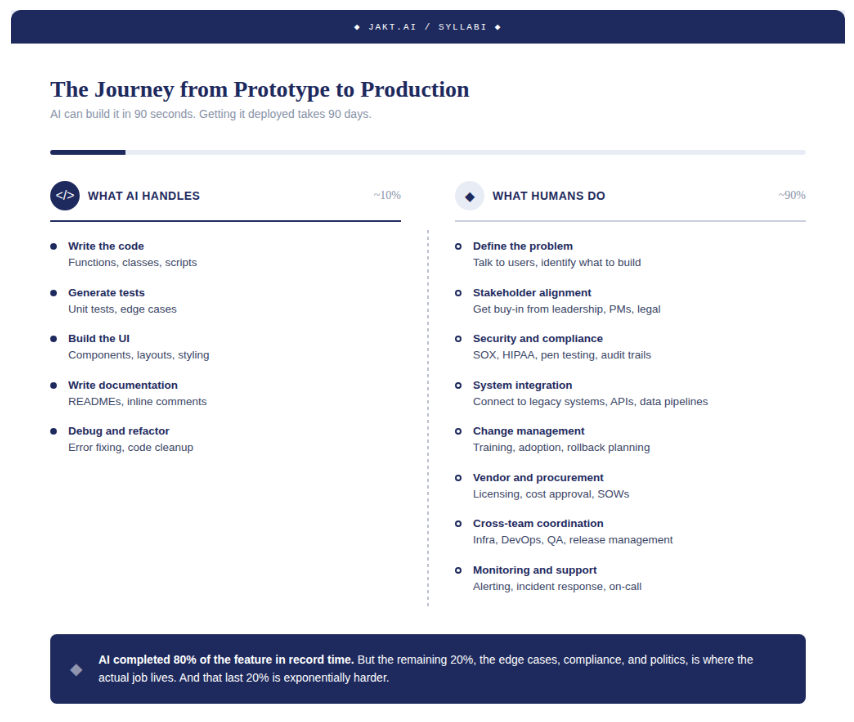
The VentureBeat team put it well when covering enterprise vibe coding: you can complete 80% of a feature in record time with AI, but the remaining 20%, the edge cases, performance tuning, and compliance work, becomes exponentially harder. That last 20% is where the actual job lives.
AI Can't Fix What Was Never a Technology Problem
That gap between prototype and production isn't just about infrastructure. Most of the time, the problems AI is being asked to solve aren't technology problems at all.
A friend in corporate finance called me last week. Their CFO wanted AI ideas. So we walked through their three biggest pain points. The first was people across the team handling the same process differently depending on who trained them. The second was decisions buried in email threads that nobody could find when it mattered. The third was managers spending hours each week chasing down status updates scattered across inboxes and side conversations.
I asked one question about each: is the problem that you don't have the right tool, or that you don't have the right process? All three were process. Every single one. No AI agent is going to fix the fact that your team has six different ways of doing the same thing because leadership decided years ago it was easier to let people do it manually than to standardize. That is a leadership problem. It was a leadership problem before ChatGPT and it will be a leadership problem after. AI doesn't fix organizational debt. People do.
OK, But Look What AI Actually Can Do
So if the hard part is people and process, what is AI genuinely good at? The output. The artifact. The thing you can point to and say "that used to take me three hours."
I asked Claude to build me a full PowerPoint presentation on this exact topic, complete with branded slides, data callouts, and charts. It took about 90 seconds. The deck below was generated entirely by AI. It's polished. It's functional. And it's maybe 5% of what it would take to actually present this to a leadership team.
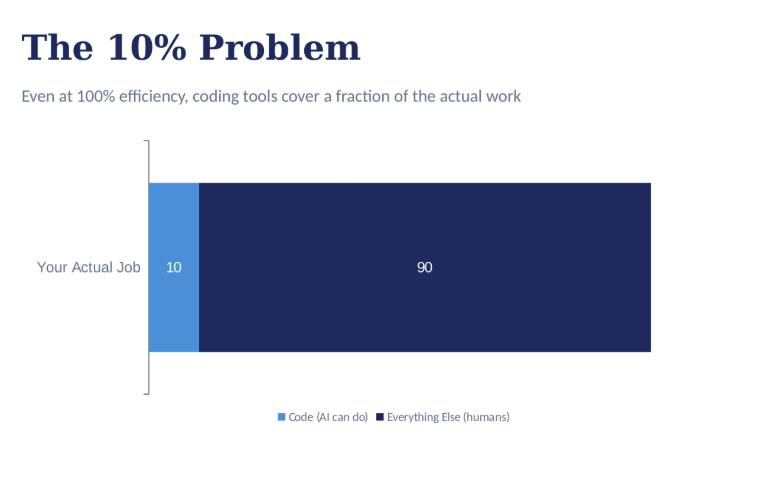
Because the other 95% is knowing your audience, reading the room, handling the question from your CFO who doesn't trust anything that wasn't built in-house, and navigating the politics of who gets credit for the idea.
That's the job. And AI isn't doing it.
The Block Layoff Is Not an AI Story
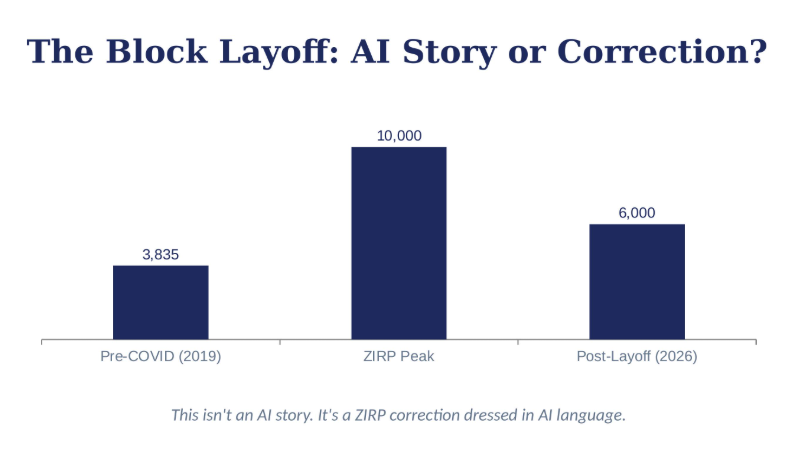
The Block layoff is going to become a template. Dorsey said it himself: "Within the next year, I believe the majority of companies will reach the same conclusion." But what conclusion are they actually reaching? Block had 3,835 employees before the pandemic. They ballooned to over 10,000 during the zero-interest hiring spree when cheap capital meant every tech company was hiring just to show growth. Now they're going back to 6,000. This isn't an AI story. This is a correction dressed up in AI language because it makes the stock go up.
What This Means For You
The real question for your career isn't whether AI can write your code. It's whether you've been building skills that live above the code. Can you translate a business problem into a technical solution? Can you get stakeholders aligned before the build starts? Can you navigate the 47 steps between "it works on my laptop" and "it's in production and compliant"?
If you can, the agents are your multiplier. If you can't, you were already vulnerable, and AI just made it visible faster.
Cherny called it perfectly when he said the title "software engineer" is going away, replaced by "builder." I'd add that the same applies outside of engineering. The title "analyst" is going away too. Replaced by someone who can think, communicate, and ship, and who happens to use AI as one of their tools.
The code was never the job. It was just the part that was easy to see.
Thank you for reading. If you like the newsletter feel free to forward along and help drive new eyes to Syllabi!